Planarity testing in hybrid bonding
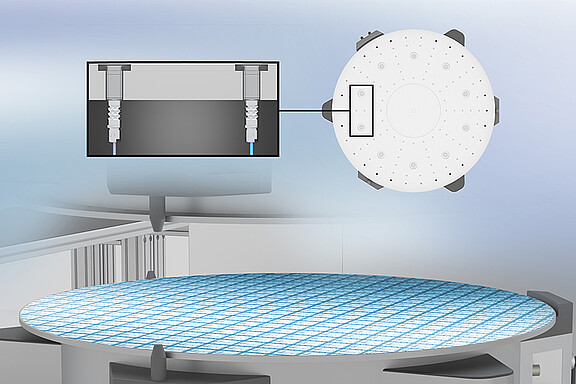
In hybrid bonding in semiconductor production, exact planarity of the wafers is crucial for stable bonding processes. Capacitive distance sensors enable high-resolution measurement of shape deviations on wafers and provide the measurement data for adaptive leveling of the bonding units.
"Hybrid bonding" is an advanced connection technology in semiconductor production in which two wafers or chips (dies) are directly connected to each other via copper contact surfaces. This eliminates the need for conventional solder balls. In modern die-to-wafer (D2W) or wafer-to-wafer (W2W) hybrid bonding, real-time planarity measurement is the decisive factor for a reliable process.
Capacitive distance sensors play a central role here by enabling the non-contact measurement of shape deviations on wafers, for example, due to deflection, twisting or local distortion. In this way, the sensors monitor the planarity of the wafers and provide essential measurement data for adaptive leveling of the bonding units.
Inline planarity control before bonding
Depending on the measurement task, sensor arrays scan the surface of the upper and lower wafer and detect local elevations, depressions, inclinations or the entire deflection. The measurement data flows into an active position correction of the wafer stages. If differences in height are detected, the bonding unit can be precisely aligned in the z-axis direction using, for example, piezo actuators or precision axes. For very small chips, segmented areas on the chuck are also used, which can be leveled locally.
Thanks to their vacuum-compatible design, these compact sensors can be used in almost all fields of application.